Cortisol isn't the villain. Read the curve.
Posted on April 24 2026
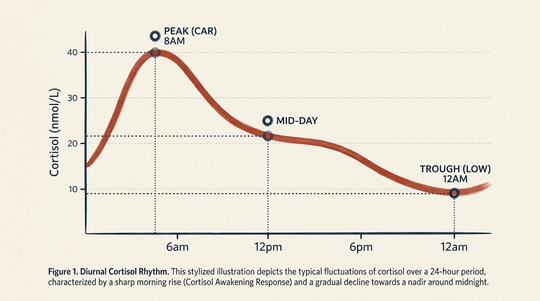
Cortisol has had a bad decade. Most wellness writing treats it as the toxic by-product of modern life — the molecule responsible for stubborn belly fat, bad sleep, and burnout, in roughly that order. The framing is wrong. Cortisol is one of the most carefully orchestrated signals your body produces. The problem isn't the hormone. The problem is the curve.
The curve, when it's working.
A healthy cortisol pattern is a daily wave. It surges roughly thirty minutes after waking — the cortisol awakening response, or CAR — and reaches a peak roughly one hour later. Then it drops, gradually but reliably, throughout the day, hitting its lowest point in the late evening. The CAR is what mobilises you in the morning. The decline is what allows melatonin to climb at night.
This curve is not optional. It's the timing signal that organises wakefulness, glucose availability, immune modulation, and the wind-down toward sleep. A flattened cortisol curve — peaks that don't peak, troughs that don't trough — is the signature of chronic stress, depression, and several metabolic conditions. The hormone isn't doing damage. The flat curve is.
How the curve goes wrong.
Three patterns turn up most often in chronic-stress populations. None of them are simply "too much cortisol."
The blunted CAR: the morning peak is small or absent. Subjectively, this feels like dragging through the first two hours of the day, no matter how much sleep was had. It's most associated with burnout, post-traumatic stress, and seasonal affective patterns.
The flattened diurnal slope: the curve doesn't drop the way it should. Cortisol stays elevated into the evening, suppressing melatonin onset and keeping people in a state of low-grade arousal at night. This is the pattern most often misread as "high cortisol" — but the absolute level is often normal. The shape is the problem.
The inverted curve: nadir in the morning, peak in the evening. Rare, severe, and almost always co-occurring with significant sleep architecture disruption. Tends to drive itself once established.
What helps, and what doesn't.
The wellness reflex is to suppress cortisol. Adaptogens, magnesium, ashwagandha — all marketed on cortisol-lowering claims. Some of these have effect. None of them treat the curve directly.
The interventions with the strongest evidence on the curve itself are unsexy. Bright morning light exposure, ideally within 30 minutes of waking, sharpens the CAR. Consistent sleep timing — same bedtime, same wake time, weekday and weekend — restores the slope. Late-evening alcohol flattens the curve more reliably than almost anything else; cutting it back two nights a week visibly changes the shape within a week or two. Late-evening caffeine does similar damage on a slower timescale.
Glycine, magnesium, and apigenin all have a role to play in supporting the wind-down side of the curve, but they're working on the slope, not on the absolute level. The framing matters.
Closing.
If you're trying to fix cortisol, you almost certainly aren't. You're trying to fix a clock that's drifted, and the clock responds to inputs the supplement aisle doesn't always sell. Read the curve. The shape is where the signal lives.