What "standardised to 0.8% valerenic acid" actually means.
Posted on April 17 2026
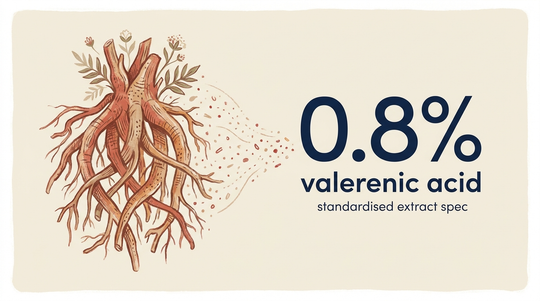
If you read sleep-supplement labels carefully, you'll notice that valerian shows up in two distinct guises. The first is "valerian root, 500mg." The second is "valerian root extract, standardised to 0.8% valerenic acid, 500mg." The numerical doses look identical. The two products will not give you the same result. The standardisation spec is doing all the work — and most customers don't know to look for it.
Powder is not extract.
Valerian root, ground into powder, contains valerenic acid (the compound responsible for most of valerian's GABA-ergic sedative effect) at variable concentrations between roughly 0.05% and 0.4% depending on the cultivar, growing conditions, and harvest timing. A 500mg capsule of raw powder might therefore deliver anywhere from 0.25mg to 2mg of valerenic acid. That's an order-of-magnitude swing in the active fraction, in a product the customer is dosing as if it's a fixed amount.
An extract, by contrast, is a concentrated preparation in which the active is enriched and quantified. A 500mg dose of extract standardised to 0.8% valerenic acid delivers exactly 4mg of valerenic acid, every capsule, every batch — assuming the manufacturer's standardisation testing is real. The form factor is the same. The active dose is fundamentally different.
Why 0.8% is the spec.
The 0.8% valerenic acid spec is what the European Medicines Agency converged on as the threshold above which valerian extracts have shown clinically reliable sleep-onset benefit in trial. Below it, results in studies are inconsistent. Above it (1.0%, 1.5%), there's no published evidence that the additional valerenic acid produces additional benefit — but there is some evidence that very high concentrations push into a different sedative window that customers report as "groggy" rather than "sleepy."
0.8% is the floor of the consistent-effect range and roughly the ceiling of the clean-effect range. It's a Goldilocks number that emerged from clinical observation rather than marketing logic. Most premium valerian extracts standardise here. Most cheap valerian products are raw powder labelled as if it were extract.
How to read a valerian label.
One word. Look for "extract." If the label says "valerian root, 500mg" with no mention of standardisation, what you have is powder, and the dose-effect relationship is uncertain. If the label says "valerian root extract, standardised to X% valerenic acid," the percentage is the meaningful number. 0.8% is the clinical reference. Anything substantially below is underdosed; anything substantially above is either marketing or pushing into the groggy-sedative window.
Closing.
The standardisation spec is the difference between a sleep aid you can rely on and one that varies batch-to-batch. Valerian is genuinely effective — at the right form, at the right dose. Read past the milligrams. The percentage is what's actually working.