The melatonin dose debate.
Posted on May 09 2026
Walk through any pharmacy in Singapore and the melatonin doses on shelf will start at 5mg and run up to 10mg. Walk through the clinical literature and the consensus dose for sleep onset starts at 0.3mg and tops out around 3mg. The shelf and the literature point in opposite directions. This is a brief argument for why the literature is right.
Melatonin is a signal, not a sedative.
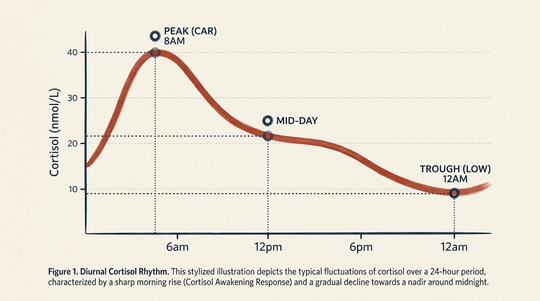
The reflex assumption with most sleep aids is that more makes you sleepier. It's the right intuition for benzodiazepines and antihistamines, both of which work by knocking out neurotransmission at the receptor level. Melatonin doesn't work like that. It's a circadian-signalling hormone — your body uses it to mark the end of biological "day" and the start of biological "night." The receptors it binds (MT1, MT2) don't dose-respond like sedative receptors do. They're modulators, not switches.
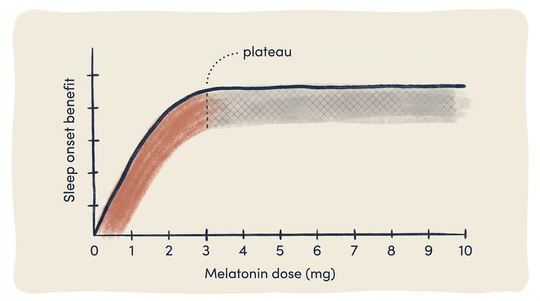
The practical implication: sleep onset benefit follows a saturation curve, not a dose-response curve. Below ~0.3mg, the signal is too weak. Between 0.3 and 3mg, the signal is reliable. Above 3mg, the receptors are already saturated. You're not getting more help to fall asleep — you're getting morning grogginess and dose-dependent tolerance.
Why retail keeps drifting up.
Retail melatonin doses have crept steadily upward over the past two decades despite no clinical reason for it. Three forces drive the drift.
Subjective ranking: more milligrams reads as more potent on a label. A 10mg product looks more "serious" than a 1mg product, even though they aren't competing on the right axis.
Tolerance compensation: a 5mg dose desensitises the receptors faster than a 1mg dose. Customers who've taken 5mg for months feel they need more — and the market obliges with 10mg products. The escalation is iatrogenic.
Quality control on the low end: 0.3mg is hard to encapsulate accurately. Many manufacturers can't dose below 1–2mg with confidence. So they don't.
What we use, and why.
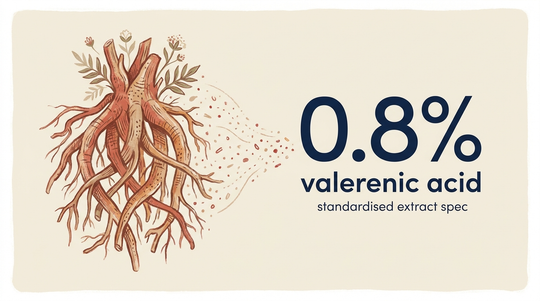
TranquilSleep dosed melatonin at 3mg deliberately — the upper bound of the clinical consensus, paired with valerian and passionflower, both of which carry real sedative weight independent of melatonin. The job of melatonin in this stack isn't to put you to sleep. It's to signal night. The valerian does the sedative work.
3mg is also the dose under review. We're considering whether 1mg (or even 0.5mg) sustains the same benefit with cleaner morning recovery. The evidence is suggestive. It's the kind of question we'd rather be wrong about than wrong about marketing.
Closing.
Melatonin is one of the easier supplements to formulate around if you respect what it actually does. It's also one of the easier ones to overdose if you don't. We'd rather take less. We think the literature is on our side.