Why most curcumin doesn't work.
Posted on May 09 2026
Curcumin is one of the most-studied molecules in supplements. It's also one of the worst-absorbed. A standard 500mg capsule of turmeric extract delivers a curcumin blood concentration so low it's borderline undetectable in many studies. The molecule that the research is excited about isn't the molecule the customer is taking. The supplement industry has known this for thirty years and is unevenly honest about it on labels.
The first-pass problem.
Curcumin is poorly soluble in water, rapidly metabolised by the liver, and excreted before it can do useful work in tissue. The first-pass effect — the liver's job of breaking down compounds before they reach systemic circulation — is brutal on raw curcumin. Most of an oral dose is converted to glucuronides and sulphates within minutes and excreted in bile. What remains in plasma is on the order of nanograms per millilitre, not the micrograms-to-milligrams the in-vitro literature uses to demonstrate effect.
This means the standard "1,000mg curcumin extract" capsule on shelf is delivering a fraction of one percent of the active molecule into circulation. The label is technically true. The biology is largely fictional.
What actually solves it.
There are four credible approaches to curcumin bioavailability, ordered roughly by how much published evidence supports them.
Phytosomes (curcumin bound to phosphatidylcholine, branded as Meriva) increase absorption ~29× over standard extract. Studied in osteoarthritis and metabolic-syndrome trials.
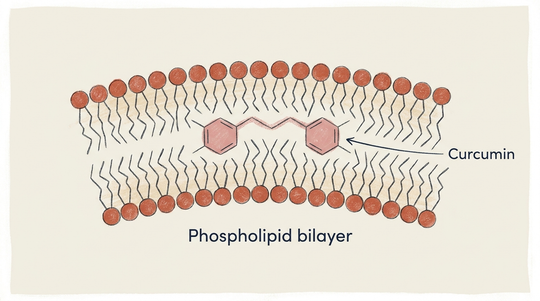
Liposomal delivery encapsulates curcumin in a phospholipid bilayer, bypassing the first-pass effect. Liposomal preparations (LPS) typically show 15–20× higher AUC than raw extract, with the additional benefit of not requiring piperine to work.
Piperine adjuncts (BioPerine, branded curcumin + black pepper) do increase curcumin plasma levels — but the mechanism is the giveaway. Piperine is a mechanism-based inactivator of CYP3A4: it generates reactive metabolites that irreversibly alkylate the enzyme protein. Recovery requires synthesising new CYP3A4, which takes days. CYP3A4 happens to clear roughly half of all clinically used pharmaceuticals. Published PBPK modelling at typical BioPerine doses (20mg/day for 7 days) predicts clinically significant interactions with at least six common drugs — simvastatin (+59% AUC), alfentanil, triazolam, cyclosporine, nifedipine, ritonavir. The "absorption booster" framing describes a metabolic brake on the liver's main clearance enzyme. It works on curcumin because it works on everything CYP3A4 was clearing. That isn't a clean win.
Nanoparticulate or micellar formulations (Theracurmin, Longvida) use particle-size engineering to improve dissolution. Effective; cost-prohibitive at higher doses.
How LPS Curcumin is dosed.
Our LPS Curcumin uses a liposomal-phospholipid system to bypass first-pass metabolism. The dose on the label reflects the absorbed-curcumin equivalent, not the raw curcumin loaded into the liposome. This is the harder spec to honour and the easier one to read.
Liposomal also means the product is taken as a small liquid dose, not a capsule. Less convenient. More effective. We made that trade deliberately.
Closing.
Most curcumin on shelf is honest about what's in the bottle and dishonest about what reaches your bloodstream. Bioavailability is the formulation question that determines whether a curcumin product is a supplement or an exercise in label compliance. We answered it with liposomes. There are other right answers. There are also a lot of wrong ones.